

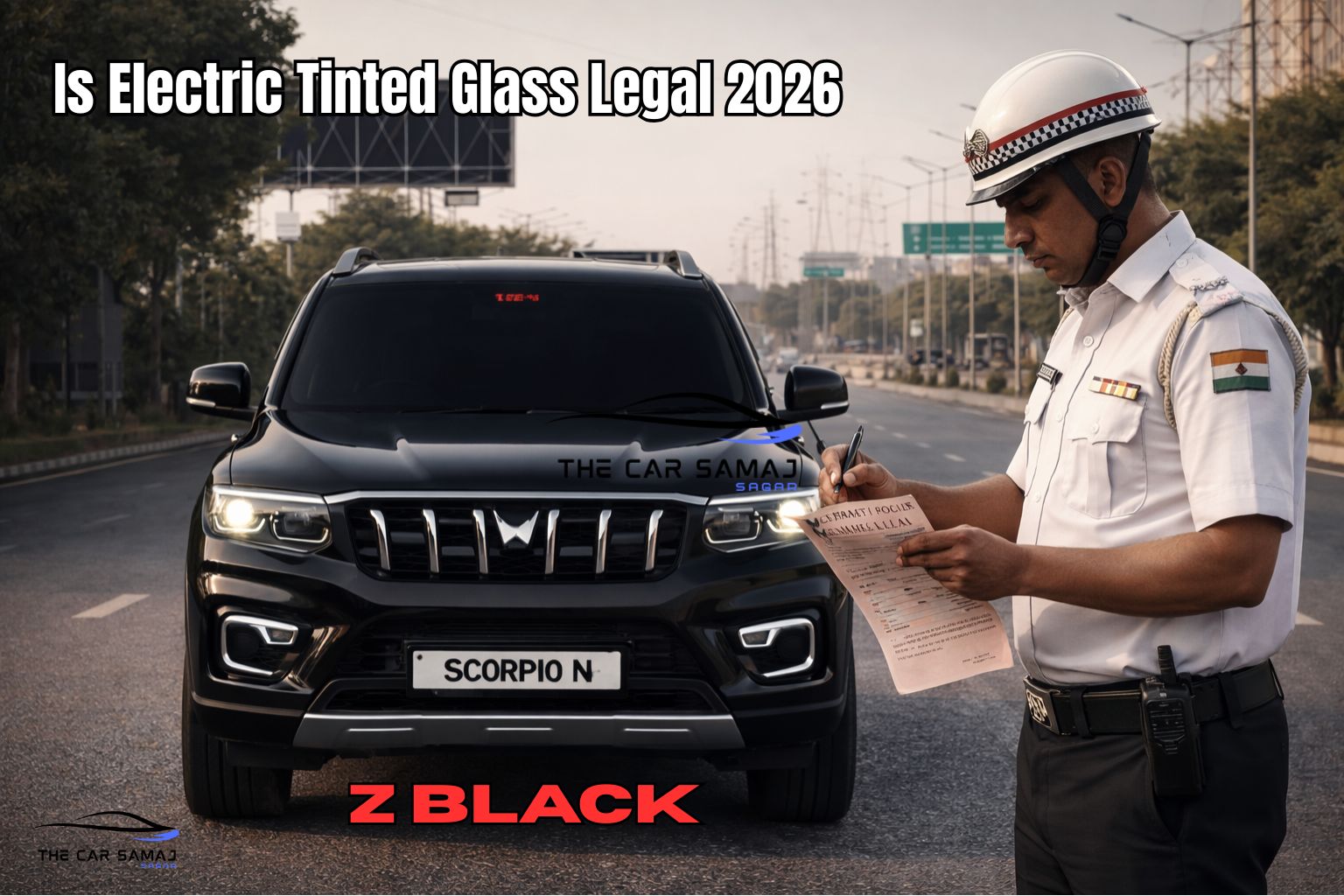
If you’re one of those people who instantly fall in love with cars that have tinted windows but are constantly worried about getting a ticket at every checkpoint and police stop—well, the game has changed. Electric tint windows have entered the car world, and these are definitely not your average roadside black window films.
Traditional black films make a car look totally gangster, but as soon as the police can’t see anything inside the windows, problems start. Electric tint windows have entered the market as a smart solution to this problem, offering not just style but also control and practicality.
Normal Black Film vs Electric Tint: Asli Difference Samjho
The “Z-black” cars you see on Indian roads today mostly have a thin black plastic film applied to them. After application, the car looks badass. But the problem starts right here.
- The police can’t see anything inside the car.
- The law strictly prohibits dark films.
- And the result? Giant fines.
Electric tint windows are not like the normal roadside black film that you just stick on and you’re done. They actually work on smart glass technology, which has a special electrochromic layer inside the glass. When an electric current passes through this layer, the glass darkens, and as soon as the current is reduced or switched off, the glass becomes clear again. This means the tint works from inside the glass, not on the surface. With this technology, you get a remote or a switch that allows you to control the tint level according to your mood and situation.
Electric tint enters the scene as a hero.
It’s not a stick-on film but smart glass technology that works from inside the glass.
How do electric tint windows work?
The principle behind electric tint windows is very simple:
There’s a special electrochromic layer inside the glass. As soon as it receives an electric current, the glass darkens.
- Less current = lighter glass
- More current = darker glass
- And the best part?
- It comes with a remote control.
The most interesting part of this system is its multi-level control. With the remote, you can decide whether you want the windows 5% dark, 15% dark, 25% dark, or a full Z-black look. Press one button and the windows darken; press another and they get even darker. And if you think it’s a bit too dark, with one click the windows return to normal. This flexibility is completely absent in traditional window films, because with those, the glass is either completely black or completely clear. This is where the real advantage of electric tint comes in.
Remote Control Functionality:
- 1 press → 5% dark
- 2 presses → 15% dark
- 3 presses → 25% dark
- 4 presses → full Z-black mode
So, tint according to your mood, with full control in your hands.
What if the police stop you? That’s where the electric tint wins the game
Now for the most common question:
“What if the police stop me and my windows are tinted?” This is where electric tint shows its true potential.
- It takes less than a minute to go from dark to clear.
- See the police approaching from a distance?
- Slow down your car.
- Adjust the tint to the normal (legal) level.
- Badass mode OFF
- Respectable mode ON
Normally, what happens is the police signal you to stop, you pull over, and if your windows are tinted, a fine is almost guaranteed. In the case of electric tint, the situation is a little different. These tints take less than a minute to change from dark to clear. So, as soon as you see a police checkpoint ahead, slow down your car, adjust the tint to the normal or legal level, and switch from badass mode back to respectable mode. This is why people are calling electric tint a future-ready solution, because the control is in the driver’s hands.
That’s why electric tint is considered future-proof, because the control is with you, not the police.
Is it legal in India or not? Hear the truth.
According to the law in India:
- Front & rear windshield: minimum 70% visibility (VLT)
- Side windows: minimum 50% visibility (VLT)
Traditional black films fail here because they are permanently dark. But the advantage of electric tint is
✔ You can switch it to clear mode.
✔ The legal limit can be followed during driving and police checks.
✔ It doesn’t look suspicious like static dark film.
It’s also important to understand the legality in India. According to the law, the front and rear windshields must have a minimum of 70% visibility and the side windows a minimum of 50% visibility. Traditional dark films fail here because they permanently reduce visibility. The advantage of electric tint is that you can keep it in clear or legal mode during driving and police checks.
Important Note:
Electric tint is only safe if you respect the legal limits. Driving with full Z-black tint on the road is still risky.
In last What is the Electric Tint Windows Key Pricing India Me
Ab aate hain sabse important part par—price.
India mein electric tint windows abhi mass-level par nahi aaye hain, isliye pricing thodi premium hai:
Approximate Price Range:
- Side windows only: ₹80,000 – ₹1.2 lakh
- Complete car (all windows): ₹1.5 lakh – ₹3 lakh+
Price depend karta hai:
- Brand
- Glass quality
- Tint levels
- Installation type (OEM / aftermarket)
Pricing ki baat karein toh electric tint windows saste nahi hote. India me side windows ke liye approx ₹80,000 se ₹1.2 lakh tak aur poori car ke liye ₹1.5 lakh se ₹3 lakh ya usse zyada bhi lag sakta hai, depending on brand aur quality. Ye solution un logon ke liye hai jo sirf style nahi, balki smart tech, privacy aur peace of mind bhi chahte hain.
Ye cheap solution nahi hai, lekin jinko luxury + tech + control chahiye, unke liye paisa justified lagta hai.
Electric tint windows look like the perfect solution for enjoying dark glass style without worrying about police challans.
Explore More on The Car Samaj
Visit – Maruti vs Mahindra: Does the company that sells more cars make more money?
Visit – All New KIA Seltos 2026 Launch at ₹11.30 Lakh | Find New look New features & Launch Date
Visit – Toyota Fortuner December 2025 Discounts ₹2 Lakh Year End Offers

Leave a Reply