

Air Suspension vs Normal Suspension: How Luxury Cars Feel Like Floating on Roads Secret | The Car Samaj
If you’ve ever driven or sat in a regular car, you’ve definitely felt how even small bumps on the road can be noticed inside the cabin. On Indian roads, this experience becomes even more noticeable due to potholes, speed breakers, and uneven surfaces.
But when it comes to luxury cars like BMW, Mercedes-Benz, or Audi, the experience is completely different. The moment you sit inside, you feel a level of comfort that almost makes it seem like the car is not driving on the road—it’s floating above it.
This isn’t just because of premium interiors or powerful engines. The real magic lies in the suspension system, especially something called Air Suspension. This advanced technology plays a crucial role in delivering that ultra-smooth, premium ride quality.
In this detailed guide, we’ll break down Normal Suspension vs Air Suspension, explain how both systems work, explore their advantages and disadvantages, and help you understand which one is better for your needs.
How Normal Suspension Works: Strong, Simple, and Reliable
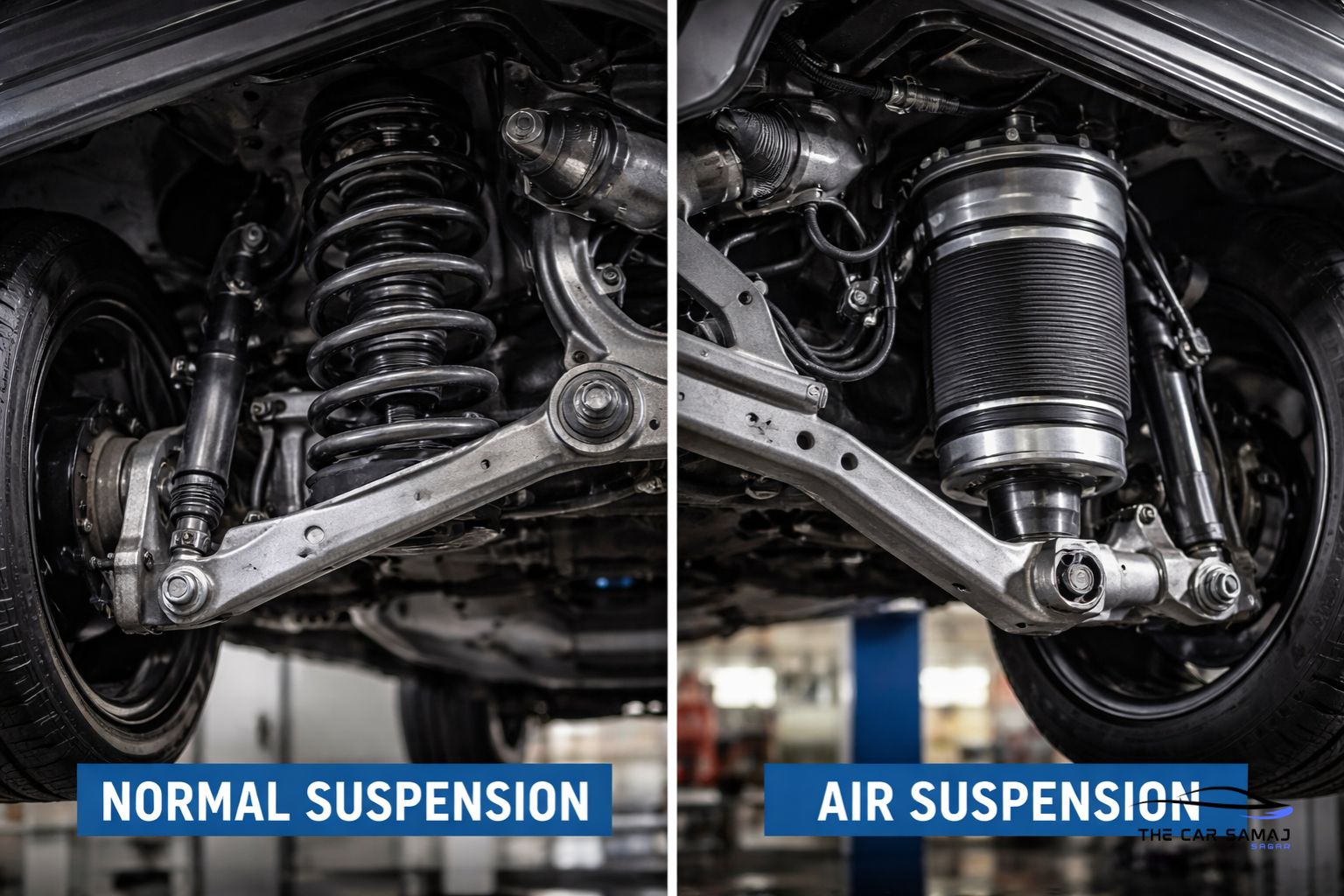
Most cars in India—such as those from Maruti, Hyundai, and Tata—use a coil spring suspension system combined with hydraulic shock absorbers. This setup is widely popular because of its simplicity and durability.
The coil spring is responsible for absorbing the impact when the car hits a bump, while the hydraulic shock absorber controls the rebound movement, ensuring that the car doesn’t keep bouncing after hitting a rough patch.
This system is designed to handle tough road conditions, which makes it highly suitable for Indian driving environments. It is strong, reliable, and can last for years with minimal maintenance.
However, the limitation of this system lies in its fixed spring rate. Since the stiffness of the spring cannot change dynamically, it has to balance between comfort and stability. As a result, while it does absorb shocks, it cannot completely eliminate the feeling of bumps inside the cabin.
That’s why even in well-tuned cars, you still feel imperfections from the road—something that luxury cars manage to hide much better.
What is Air Suspension and Why Is It So Special?
Air suspension replaces traditional metal springs with rubber or polyurethane air springs (airbags). Instead of relying on fixed mechanical stiffness, this system uses compressed air to support the vehicle’s weight.
An onboard air compressor, along with sensors and an electronic control unit (ECU), continuously adjusts the air pressure inside these airbags. This allows the suspension to adapt in real-time based on road conditions, speed, and load.
The result is a ride quality that feels incredibly smooth—almost like sitting on a cushion of air. Road imperfections are absorbed so effectively that passengers often feel disconnected from the roughness of the surface below.
This is the core reason why luxury cars deliver such a refined and premium driving experience.
Advanced Features of Air Suspension That Change Everything
One of the biggest advantages of air suspension is that it’s not just about comfort—it’s also about intelligence and adaptability.
At high speeds, the system automatically lowers the car’s height. This improves aerodynamics and reduces the center of gravity, making the vehicle more stable and efficient on highways.
On rough roads or during off-road conditions, the suspension can raise the vehicle, increasing ground clearance and preventing damage to the underbody. This adaptability makes it highly versatile compared to traditional systems.
Another major benefit is load leveling. In regular cars, if you add more passengers or luggage, the rear of the vehicle tends to sag. With air suspension, the system automatically compensates by adjusting air pressure, keeping the car perfectly balanced regardless of load.
All of this happens automatically, without driver intervention, making the driving experience seamless and premium.
The Downsides of Air Suspension: What You Should Know
While air suspension offers unmatched comfort and advanced features, it does come with certain drawbacks.
The system is significantly more complex than traditional suspension setups. It involves multiple components such as compressors, sensors, air lines, and control units, all of which can fail over time.
Maintenance and repair costs are also much higher. If an air spring gets damaged or the compressor fails, the repair bill can be quite expensive—sometimes running into thousands (or even lakhs in India).
Additionally, air suspension systems are more sensitive to environmental conditions like dust, moisture, and extreme temperatures, which can affect long-term reliability, especially in challenging driving conditions.
This is why most budget and mid-range cars still rely on traditional suspension systems.
India’s EV Revolution: Upcoming Electric Cars in India 2026 | The End of Petrol Cars?
Which One is Better? The Final Verdict
Choosing between normal suspension and air suspension depends entirely on your priorities and budget.
If you are looking for a low-maintenance, durable, and cost-effective solution, then normal suspension is the clear winner. It is reliable, practical, and perfectly suited for everyday use, especially on Indian roads.
However, if your priority is ultimate comfort, advanced technology, and a premium driving experience, then air suspension stands in a league of its own. It offers a level of ride quality that traditional systems simply cannot match.
Luxury always comes at a cost, and air suspension is a perfect example of that trade-off.
EV vs CNG in India 2026: Which Saves You More Money? | The Car Samaj
Conclusion: Experience Defines the Difference
At the end of the day, the difference between these two systems is not just technical—it’s experiential.
Normal suspension gets the job done efficiently and reliably, while air suspension transforms the entire driving experience into something truly luxurious.
If your budget allows, experiencing a car with air suspension at least once is highly recommended. It completely changes your perception of what a smooth ride should feel like.
For more deep, practical, and easy-to-understand automotive insights, stay connected with The Car Samaj—your go-to destination for real car knowledge.
FAQs






Leave a Reply