

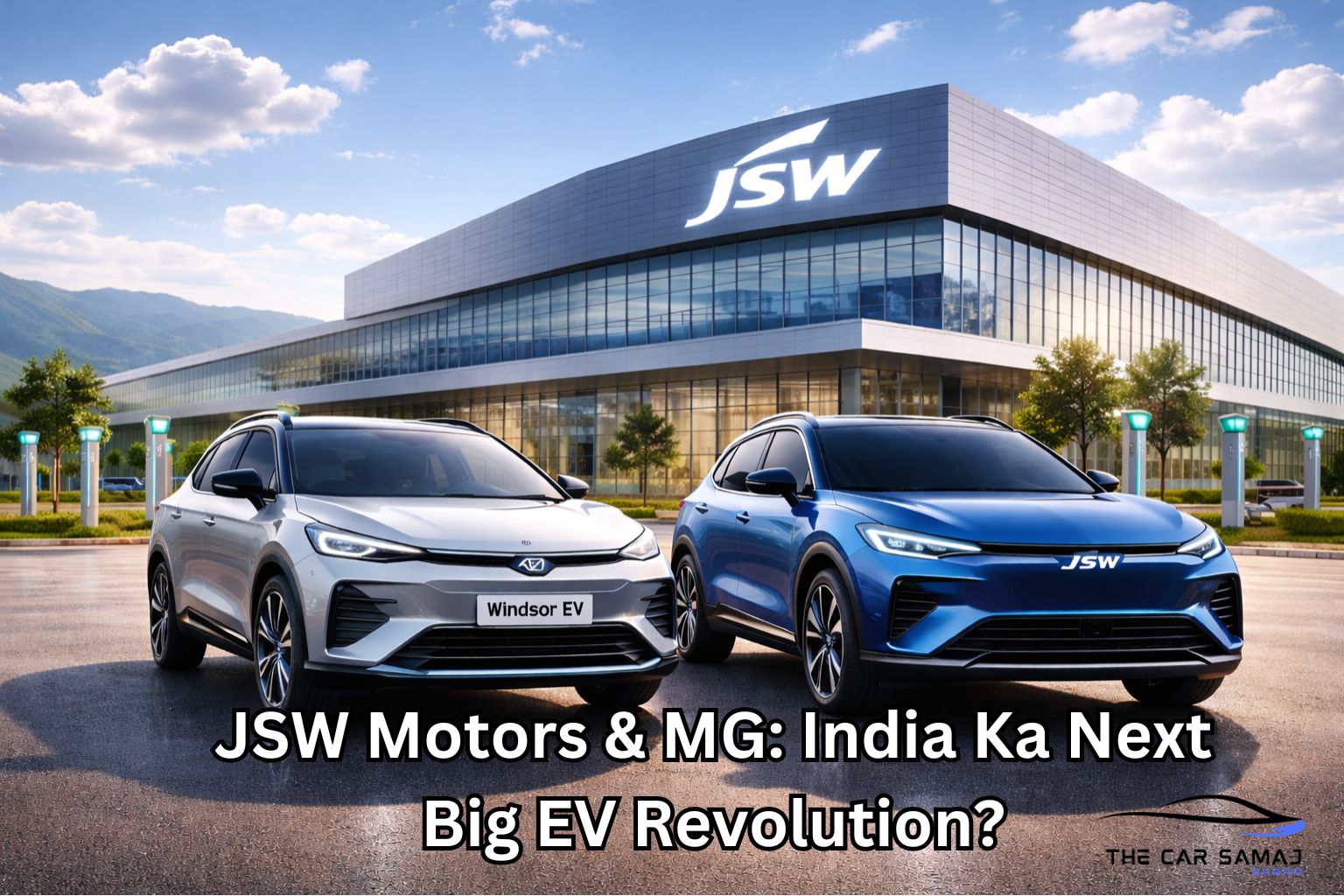
Jasw Motors’ Master Plan: A New Story for India’s Automotive Future
If you look back at Indian automobile history, the Maruti Suzuki moment of the 1980s comes to mind. At that time, one company transformed the entire car market with affordable, reliable, and mass-market cars. Today, almost 40 years later, a similar bold claim is being made, but this time not for petrol or diesel vehicles, but for the electric future. This claim comes from Sajjan Jindal, Chairman of the JSW Group.
Instead of starting from scratch, JSW chose a smart shortcut. They acquired a 51% stake in MG Motor India’s Indian operations. The implication of this move is simple—JSW instantly gained a fully functional manufacturing plant located in Halol, Gujarat, along with an already established nationwide dealer network.
The core idea behind this strategy is not just “making cars,” but manufacturing EVs at scale. JSW aims to sell 1 million electric vehicles in India by 2030. This number is not only ambitious but clearly indicates that JSW is not just participating in this race but aiming to win it.
The most interesting part is that while working under MG Motor India, the group is also developing an independent homegrown brand—JSW Motors, which is expected to debut around late 2026 or 2027. This means on one hand, they have MG’s global experience, and on the other, a proper “Made-for-India” electric brand. This dual-brand strategy could prove compelling for the Indian market.
New Energy Vehicles Par Full Focus: JSW MG Ki EV Lineup
JSW and MG have a clear stance—the future belongs to NEVs (New Energy Vehicles). This means not just electric cars, but also smart tech, connected features, and cost-efficient ownership. Today’s Indian buyer doesn’t just want mileage; they want an experience, and JSW MG is moving in this direction.
First, let’s talk about the MG Windsor EV, which is currently their most successful offering. This car falls into a unique segment that the company calls “”CUV”—combining the comfort of a sedan with the space of an SUV. In this model, the customer can buy the car at a relatively lower price (starting from around ₹9.99 lakh) and pays a per-kilometer usage charge for the battery, which is roughly around ₹3.9/km.
The biggest fear regarding EV adoption in the Indian market is the battery replacement cost, and the BaaS model significantly reduces that fear.
Now, if you think EVs are boring, the MG Cyberster might change your opinion. This is an all-electric luxury roadster that looks and performs like a supercar. 0–100 km/h in just 3.2 seconds and over 500 bhp of power—these numbers clearly indicate that MG is targeting not only the mass market but also premium enthusiasts. Its price in India is set at around ₹72–75 lakh, and it has been launched under the “MG Select” premium banner.
Another interesting name in the future lineup is the MG Cloud EV (or Excelor). This car is being designed for buyers who prefer chauffeur-driven comfort. Sofa-style fully reclining seats, a large 15.6-inch infotainment screen, and a premium interior vibe—all these features make it an urban luxury EV, without the heavy price tag of a traditional luxury car. And finally, the Binguo EV hatchback for the mass market. This car is coming to directly challenge models like the Tata Tiago EV.
Jasw’s real advantage: Not just a car, but a complete EV ecosystem.
This is where JSW MG’s biggest advantage comes into play. They don’t just want to be a company that assembles cars. JSW’s vision is to build an end-to-end EV ecosystem, where everything from batteries to charging is managed in-house or locally.
JSW is investing approximately ₹40,000 crore in Odisha for a massive 50 GWh battery manufacturing plant. In the Indian EV market, battery cost is the biggest price-determining factor. Companies that currently import batteries find it difficult to control costs. But if JSW manufactures batteries locally, their cars can naturally be more affordable than those of their competitors.
Furthermore, JSW already has a strong presence in the steel and energy sectors. This means that a significant portion of the supply chain, from chassis manufacturing to raw materials and power supply, will be under their control. In the long term, this localization strategy can provide them with price stability and better margins, which will ultimately benefit customers as well.
JSW is also taking an aggressive approach to charging infrastructure. One of the major roadblocks to EV adoption in India is “range anxiety”—people worry that charging stations won’t be readily available. JSW is working to address this issue by expanding its nationwide charging network, especially along highways and in urban centers.
Final verdict: Jasw Motors is not just a brand, it’s a statement.
If you want to understand everything in a nutshell, JSW Motors is a statement of Indian industrial ambition. By partnering with MG, JSW has skipped the learning phase and directly entered the scaling phase. They have manufacturing capabilities, capital, raw materials, technology, and a long-term vision—everything is aligned.
In the next 2-3 years, if you’re looking for a tech-heavy, value-for-money electric car, there’s a high chance that JSW MG will be on your shortlist. Whether it’s a practical family car like the Windsor EV, budget city EVs like the Binguo, or a halo performance car like the Cyberster, JSW MG’s portfolio is trying to attract every type of buyer.
The Indian auto market is undergoing a major transition, and JSW Motors wants to be not just a part of that transition but a driver of it. If their execution plan is strong, in the future we might even remember the 2020s as the “JSW EV era.”
What do you think about JSW Motors and MG’s electric future?
Could MG Windsor EV’s Battery-as-a-Service model be a game-changer in India, or are you waiting for the budget EV hatchback (Binguo)?
Share your opinion in the comments below.
And if you want to read about future EVs, upcoming car launches, and real-world analysis, don’t forget to bookmark the blog.
Explore More on The Car Samaj
Visit – Are Supercars Really an Investment? Cristiano Ronaldo’s Billionaire Logic Explained
Visit – India vs USA Car Culture: Why Street Racing Stories Go Viral but Roads Demand Safety
Visit – Tuned BMWs in Trouble? Here’s What the New Engine Access Rule Means
FAQs

Leave a Reply