

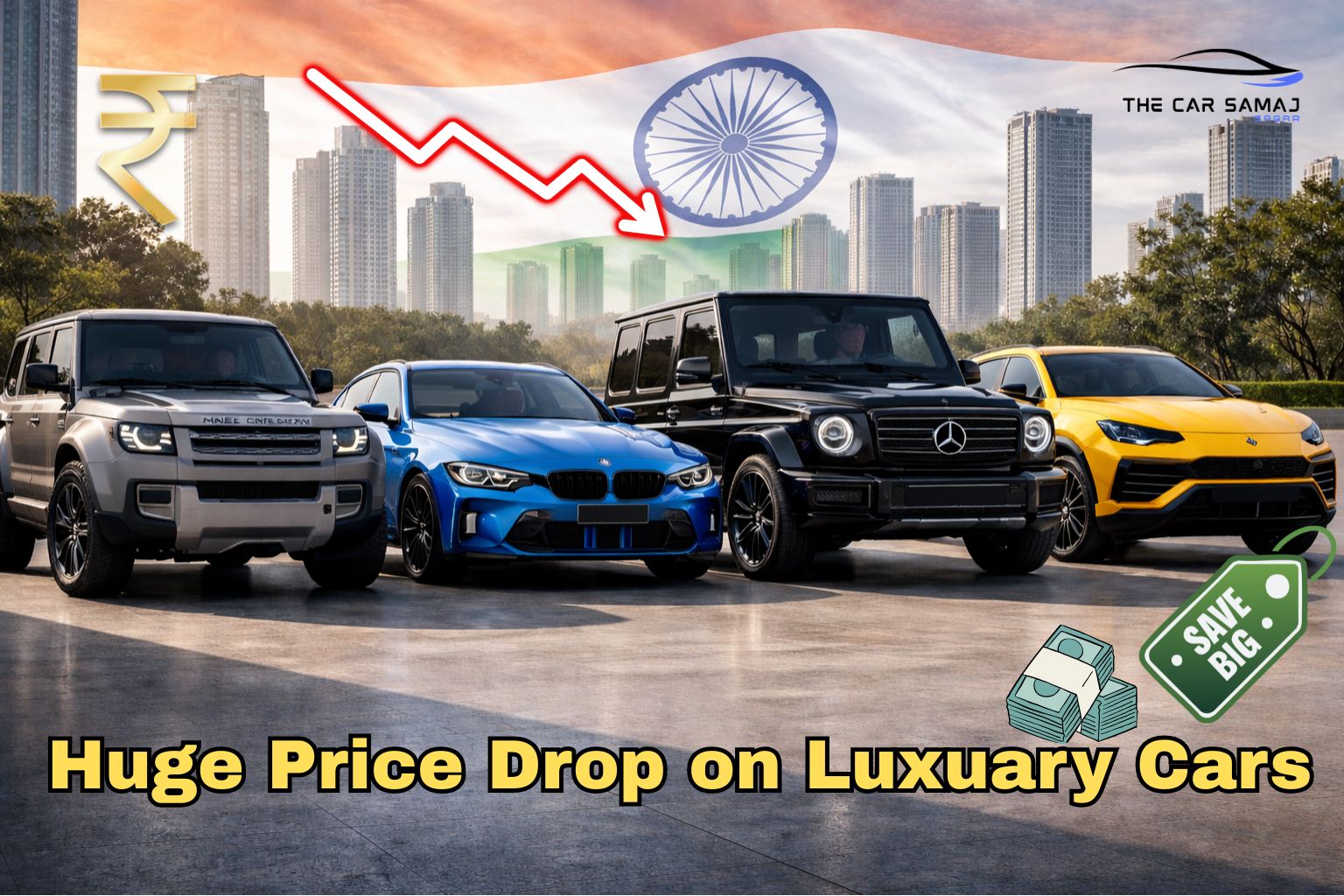
Are luxury cars getting cheaper? Viral claims, the India-EU FTA, and the real truth.
For some time now, a claim has been going viral on social media—that the prices of luxury cars like the Defender, BMW, Mercedes G-Wagon, and Lamborghini are going to drop by crores of rupees. The claims are so shocking that people are saying things like, “Buy a BMW and get a Fortuner for free,” or “The Lamborghini Urus will now cost only 3.6 crore rupees.” While this sounds exciting, when the whole matter is examined calmly and factually, a different picture emerges.
The reality is that the viral message contains some truth but also a lot of exaggeration. The price drops being mentioned are not possible overnight, nor has the government launched any instant discount scheme that would suddenly halve the prices of luxury cars. There is a real policy behind this whole discussion, but its implementation is slow, phased, and limited.
In this blog, we will break down the viral claims and, using the exact facts of the India-EU Free Trade Agreement (FTA), understand what is true, what is misleading, and what luxury car buyers should realistically expect.
| Car Model | Claimed New Price (₹ On-Road) | Realistic Long-Term Price (₹ On-Road) | Reality Check / Notes |
|---|---|---|---|
| Land Rover Defender 110 | ₹80 Lakh | ₹95 Lakh – ₹1.05 Cr | Import duty kam hogi, lekin GST (40%), road tax aur registration charges price ko high rakhenge |
| BMW M4 Competition | ₹1.22 Cr | ₹1.35 Cr – ₹1.45 Cr | Claimed ₹58 lakh ka fayda tabhi possible jab phased duty cuts 5+ saal baad fully apply hon |
| Mercedes G-Wagon 450D | ₹2.32 Cr | ₹2.60 Cr – ₹2.80 Cr | Viral claim GST calculation ko ignore karta hai, jo landed cost par lagta hai |
| Lamborghini Urus | ₹3.60 Cr | ₹4.10 Cr – ₹4.30 Cr | ₹2 crore ka drop practically possible nahi hai due to cess, GST aur local taxes |
India-EU Free Trade Agreement: What is the “latest scheme” really about?
The “latest scheme” repeatedly referenced in the viral content is actually the Free Trade Agreement (FTA) signed between India and the European Union. This agreement was officially finalized on January 27, 2026, and is considered a historic step for the Indian auto industry.
Under this FTA, India has agreed to gradually reduce the heavy import duty on European cars. Currently, imported luxury cars attract import duties of up to 110%, making high-end vehicles extremely expensive in India. According to the FTA, this duty will be reduced to 10% over a period of 5 to 10 years.
However, an important clarification is needed here this reduction will not be implemented immediately. It will be implemented step-by-step, and will apply to a limited number of cars each year. This does not mean that the announcement was made today and tomorrow cars will be available in showrooms for 1-2 crore rupees cheaper.
The implementation of this agreement will realistically begin in FY 2027-28, and it will take several years to see the full benefits.
Quotes, timelines, and ground realities that were missing in the viral script.
The biggest problem with the viral transcript is that it ignores the timeline and quota system. The government has set an annual cap of 250,000 vehicles per year. This means that not every imported European car will receive this benefit.
Furthermore, even with the reduced duty, GST, road tax, registration charges, and state-wise levies will remain the same. Luxury SUVs still attract around 40% GST, which is calculated on the landed cost. Therefore, the final on-road price won’t see the dramatic drop that is being claimed in the reels and shorts, simply due to the reduction in import duty.
Another factor that is completely ignored in the viral content is the depreciation of the Indian rupee against the euro. Between 2025 and 2026, the INR has weakened by approximately 19-20%, and according to industry experts, this currency loss will already offset a significant portion of the import duty reduction.
This means that the savings that appear significant in theory may be largely neutralized at the ground level.
Claimed Prices vs Realistic Prices: Numbers Ka Sach
Now let’s look at the specific cars whose prices have generated the most hype. There’s a significant difference between the numbers mentioned in the viral transcript and the realistic long-term impact.
For the Land Rover Defender 110, it was claimed that the price would drop from ₹1.26 crore to ₹80 lakh. In reality, even after the duty reduction, including GST and local taxes, the realistic long-term price is likely to be between ₹95 lakh and ₹1.05 crore. This means the price will decrease, but not as much as claimed.
In the case of the BMW M4 Competition, the claim of a drop from ₹1.80 crore to ₹1.22 crore is quite misleading. Realistically, after phased duty cuts, its on-road price might settle in the ₹1.35–1.45 crore range, and that too only after a significant portion of the agreement has been implemented.
The ₹1.17 crore “direct benefit” mentioned for the Mercedes G-Wagon 450D ignores GST calculations. In a practical scenario, its price is likely to settle around ₹2.60–2.80 crore, not ₹2.32 crore.
The most exaggerated claim is regarding the Lamborghini Urus. A drop from ₹5.60 crore to ₹3.60 crore is mathematically almost impossible, as cess and state taxes are still substantial. In a realistic long-term scenario, the Urus might fall into the ₹4.10–4.30 crore range, which is a discount, but not a “₹2 crore benefit.”
The middle class, EVs, and the “Make in India” angle are all important aspects to understand.
One thing the viral transcript gets right is that these cars will still remain out of reach for the middle class. A car costing ₹80 lakh or ₹1.3 crore is not within the budget of the middle class, whether there’s a discount or not.
The government has deliberately excluded mass-market cars priced below ₹25 lakh from this duty reduction to protect domestic manufacturers and promote “Make in India.” No duty cuts have been given for the affordable segment.
Similarly, electric vehicles (EVs) have also been excluded from the FTA for the first five years. The clear reason for this is to protect Indian EV players like Tata and Mahindra from foreign competition.
Therefore, this entire FTA is a long-term positive signal for luxury car buyers, not for the middle class.
They will indeed be cheap, but not at the speed shown in the reels.
In conclusion, it’s simple. Luxury cars will be cheaper in India, there’s no doubt about that. The India-EU FTA is a real, signed, and historic deal. However, the overnight discounts of crores of rupees shown in the viral transcript are highly sensationalized.
The duty reduction will happen in a phased manner over 5-10 years, with limited quotas, and factors like currency depreciation and GST will largely offset the savings. Therefore, claims like getting a Fortuner free with a BMW or a Lamborghini at half price are more of a marketing gimmick than the actual reality.
In short:
- The claim is partially true.
- The timeline is incorrectly projected.
- The numbers are inflated.
This could be a long-term win for luxury car buyers, but not an instant jackpot.
What is your opinion on this India-EU FTA? Is this deal beneficial for businesses or just for generating headlines? Share your views in the comments section.
Explore More on The Car Samaj
Visit – Renault Duster 2026 at ₹10 Lakh, Booking Date on | View All Important Info on The Car Samaj
Visit – New Renault Duster 2026 Comeback On 26 Jan 2026 at ₹10 Lakh
Visit – 2026 Mahindra XUV 7XO Complete Guide: Price, Variants, Mileage & Safety
FAQs





Leave a Reply